Reverberation Time (RT60) & Acoustic Panel Calculator
Echo is measured as reverberation time: how long a sound takes to fade by 60 dB. Sabine's equation, RT60 = 0.049 × volume ÷ absorption, turns the gap between the time your room has now and the time you want into square feet of absorption, and that into a number of panels. A 12 × 15 × 8 ft office that rings for 0.8 s needs about 88 more sabins to reach 0.4 s: twelve 2 × 4 ft panels with an NRC of 0.95.
Your project
Measure it with a free RT60 app and a hand clap, or use the 'Estimated' figure from a similar room.
From the panel's data sheet (tested to ASTM C423). Thicker panels usually score higher.
Your results
- Acoustic panels needed
- 12 panels
- 96 sq ft of panel face at 7.6 sabins each
- Absorption to add
- 88.2 sabins
- from 88.2 now to 176.4 at the target
- RT60 after the panels
- 0.39 s
- Room volume
- 1,440 cu ft
- Average absorption coefficient now
- 0.111
- over 792 sq ft of walls, floor and ceiling
Estimates use typical US material and labor pricing. Confirm quantities against the coverage chart on the bag before you buy.
Gear for this job
Acoustic Soundproofing Panels

ZHOJEREL 5 Pack Sound Proof Foam Panels for Walls 47.2"x23.6" Large Acoustic Panels Sound Absorbing, Self-Adhesive Soundproof Wall Panels for Home Studio, Office, Recording, Black Black
$66.99
Check price on Amazon

24 Pack Black 2"X 12" X 12" Inches Egg Pattern Designed Acoustic Foam Panels ,Sound Proof Foam Panels for Walls,High Density Sound Acoustic Panels for Recording Home Studio Recording Office
$30.99
Check price on Amazon

FONESO Acoustic Panels, High Density Soundproof Foam Panels, Fire Resistant Sound Absorbing Acoustic Foam Panels for Studio Recording, Black 1"x12"x12" 12 Pack with Adhesive
$14.96
Check price on Amazon
Rockwool Safe N Sound

Rockwool 8# Density Foil-Faced Stone Wool Insulation Mineral Wool Panels, Batts - 2" Thick, 2'x4' (7) per Pack, Pro-Grade Acoustic Soundproofing, Thermal Barrier & Fire Block
$259.70
Check price on Amazon
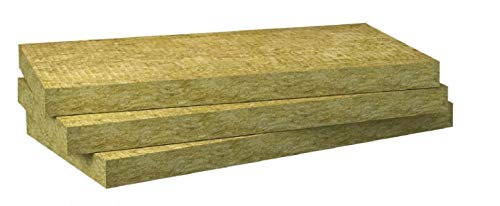
Roxul, Rockwool Mineral Wool Board, ProRox SL940 (6# Density), 48" x 24"x 3" Thick
$248.04
Check price on Amazon
ProRox SL 960 Rockwool, Roxul, Mineral Wool Insulation Board High Temperature 8# Density 4"
$227.90
Check price on Amazon
Mineral Wool Insulation Batts
Rockwool 8# Density Foil-Faced Stone Wool Insulation Mineral Wool Panels, Batts - 2" Thick, 2'x4' (7) per Pack, Pro-Grade Acoustic Soundproofing, Thermal Barrier & Fire Block
$259.70
Check price on Amazon
ProRox SL 960 Rockwool, Roxul, Mineral Wool Insulation Board High Temperature 8# Density 4"
$227.90
Check price on Amazon

1 1/2 in x 48 in x 24 in Mineral Wool High Temperature Insulation, 8#, Mfr: 40325-A
$46.00
Check price on Amazon
As an Amazon Associate I earn from qualifying purchases. Product links on this page may earn us a commission at no extra cost to you.
Prices as of Oct 1, 2026, 4:38 AM UTC. Product prices and availability are accurate as of the date/time indicated and are subject to change. Any price and availability information displayed on Amazon.com at the time of purchase will apply to the purchase of this product.
How this calculator works
- RT60 = 0.049 × V ÷ A (V in cu ft, A in sabins) — Sabine; metric 0.161 × V ÷ A
- Absorption now = 0.049 × V ÷ RT60 now; absorption needed = 0.049 × V ÷ RT60 target
- Sabins per panel = panel face area × NRC
- Panels = (absorption needed − absorption now) ÷ sabins per panel, rounded up
Panels to go from 0.8 s to 0.4 s (24 × 48 in panels, NRC 0.95)
| Room | Volume | Sabins to add | Panels |
|---|---|---|---|
| Bedroom 12 × 12 × 8 ft | 1,152 cu ft | 70.6 | 10 |
| Home office 12 × 15 × 8 ft | 1,440 cu ft | 88.2 | 12 |
| Living room 16 × 20 × 9 ft | 2,880 cu ft | 176.4 | 24 |
| Basement studio 20 × 25 × 8 ft | 4,000 cu ft | 245 | 33 |
Computed with this calculator. Halving RT60 always means doubling the room's absorption.
What reverberation time should a room have?
Shorter is clearer for speech, and a room can be made too dead for music. The one widely cited US target is the classroom acoustics standard ANSI/ASA S12.60, which asks for 0.6 s or less in learning spaces up to 10,000 cu ft. Home offices and video-call rooms are usually aimed lower than that, and listening rooms are tuned by ear around the result you like. Set your own target and the calculator does the arithmetic.
Sabine's equation assumes sound is spread evenly through the room. It is a planning tool for ordinary rooms; very small booths, rooms with one very absorbent surface and large halls need measurement or a more detailed model.
Panels treat echo, not noise from next door
Absorption shortens the echo inside a room. It does very little to stop sound passing through a wall, which depends on mass, airtightness and decoupling. To keep noise in or out, see the soundproofing calculator for insulated cavities and wall assemblies.
Spread panels over several walls and the ceiling rather than covering one wall, start at the first reflection points beside and above where you sit, and remember that soft furnishings, rugs and bookcases add absorption too: measure again after moving in.
Keep going
- Blocking sound between rooms: soundproofing calculator
Frequently asked questions
How do you calculate reverberation time?
With Sabine's equation: RT60 = 0.049 × room volume in cubic feet ÷ total absorption in sabins (0.161 × volume in m³ ÷ absorption in m² sabins). A sabin is one square foot of perfect absorption; a panel adds its face area times its absorption coefficient.
How many acoustic panels do I need?
Work out the absorption the room needs for your target RT60 (0.049 × volume ÷ target), subtract what it has now (0.049 × volume ÷ current RT60), and divide by the sabins per panel (area × NRC). A 12 × 15 × 8 ft room going from 0.8 s to 0.4 s needs 88.2 sabins: twelve 2 × 4 ft panels at NRC 0.95.
What is NRC?
The noise reduction coefficient: the average of a material's absorption coefficients at 250, 500, 1,000 and 2,000 Hz, measured to ASTM C423 and rounded to the nearest 0.05. 0 reflects everything; 1 absorbs everything in that range.
How do I measure my room's RT60?
Use a free reverberation-time app on a phone: make a sharp sound such as a clap or balloon pop and the app times the decay. Take a few readings in different spots and use the average.
Related calculators
Free app
Run this calculator on your phone
Offline-ready, saves your results, no signup.
Acoustic panels needed
12 panels