Radiant Barrier Calculator
Radiant barrier reflects summer heat back out of the roof deck. It shines in hot climates. Enter your attic footprint and roof pitch for roll counts and savings.
Your project
Covers cuts, compression and odd bays. 10% is the usual default.
Your results
- Roof deck area to cover
- 1,478 sq ft
- Rolls required
- 3 rolls
- 500 sq ft per roll
- Staples estimate
- 370 staples
- Roughly every 4 sq ft
- Material cost
- $325
- Expected cooling savings
- 12%
- Highest in hot, sunny climates
- Best value verdict
- Strong payback
Estimates use typical US material and labor pricing. Confirm quantities against the coverage chart on the bag before you buy.
Save this calculation in the free app
Smart Insulation Calculator keeps your insulation jobs on your phone, offline. On iPhone? It's inside Roofing Calculator & Estimator.
Gear for this job
Radiant Barrier Foil Insulation
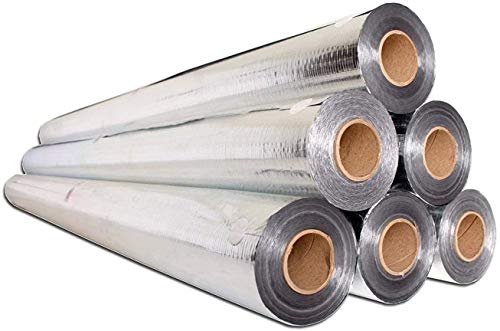
US Energy Products Radiant Barrier Insulation 1000 sqft (4ft Wide) Commercial Grade Perforated No Tear Green Energy Radiant Barrier Reflective Insulation Solar Attic Foil Roof House Wrap SCIF RIFD
$129.11
Check price on Amazon

ZXQDRE Radiant Barrier Insulation Roll, 1000 Sq Ft Perforated Attic Foil
$135.99
Check price on Amazon

Radiant Barrier, Radiant Barrier Insulation Roll, 250' x 4', 1000 Sq Ft
$151.99
Check price on Amazon
Reflective Attic Insulation Roll


Staple Gun Insulation

Arrow 508 Heavy Duty T50 1/2-Inch Leg Length, 3/8-Inch Crown, Staples for Upholstery, Construction, Furniture, Crafts, 1250 Count(Pack of 1)
$3.97
Check price on Amazon

Upholstery Staple Gun Heavy Duty, YEAHOME 4-in-1 Stapler Gun with 4000 Staples, Manual Brad Nailer Power Adjustment Stapler Gun for Wood, Crafts, Carpentry, Decoration DIY
$16.99
Check price on Amazon

meite T50 Staples, 3/8 Inch Staples for Staple Gun, Heavy Duty Galvanized Staples, 20 Gauge 3/8" Crown, Compatible with T50 Staple Gun, Ideal for Upholstery, Construction, Furniture (1,512 Counts)
$6.98
Check price on Amazon
As an Amazon Associate I earn from qualifying purchases. Product links on this page may earn us a commission at no extra cost to you.
Prices as of Oct 11, 2026, 4:41 AM UTC. Product prices and availability are accurate as of the date/time indicated and are subject to change. Any price and availability information displayed on Amazon.com at the time of purchase will apply to the purchase of this product.
How this calculator works
- Roof deck area = attic floor area × pitch multiplier
- Rolls = deck area ÷ (roll width × roll length)
- Savings % depends on climate zone — hot zones benefit most
Frequently asked questions
Does a radiant barrier work in cold climates?
Barely. It reflects summer heat gain, so payback is real in zones 1 to 3 and marginal from zone 5 north. Cold-climate money is better spent on attic depth and air sealing.
Should radiant barrier be stapled to the rafters or laid on the attic floor?
Stapled to the underside of the rafters is standard — laying it on top of insulation collects dust, which kills reflectivity within a few years.
How much does radiant barrier cost?
Material is about $0.22 per sq ft of roof deck for perforated foil. A 1,500 sq ft attic at a typical 1.12 roof-slope factor has about 1,680 sq ft of deck, so roughly $370 of foil plus staples. Labor is the bigger variable: stapling to rafters in a tight attic is slow, awkward work, which is why installed quotes run several times the material price.
Does a radiant barrier actually work?
In hot sunny climates with ducts in the attic, it can make a measurable difference by reflecting radiant heat off the roof deck. In cold climates it does very little, because the dominant heat flow is conductive rather than radiant. It is a climate-dependent product being sold as a universal one, which is where most of the disappointment comes from.
Does a radiant barrier need an air gap?
Yes, and this is the thing most installations get wrong. A reflective surface in contact with another material conducts through the contact instead of reflecting across a gap. Laid straight onto existing insulation, a radiant barrier does almost nothing — it needs an air space facing it to function at all.
Can a radiant barrier replace insulation?
No. It addresses one of three heat transfer paths and does nothing about conduction through the ceiling. It is an addition to attic insulation in the right climate, not a substitute for depth, and any product marketed as replacing R-value should be treated with suspicion.
Related calculators
Free app
Run this calculator on your phone
Offline-ready, saves your results, no signup.
Roof deck area to cover
1,478 sq ft